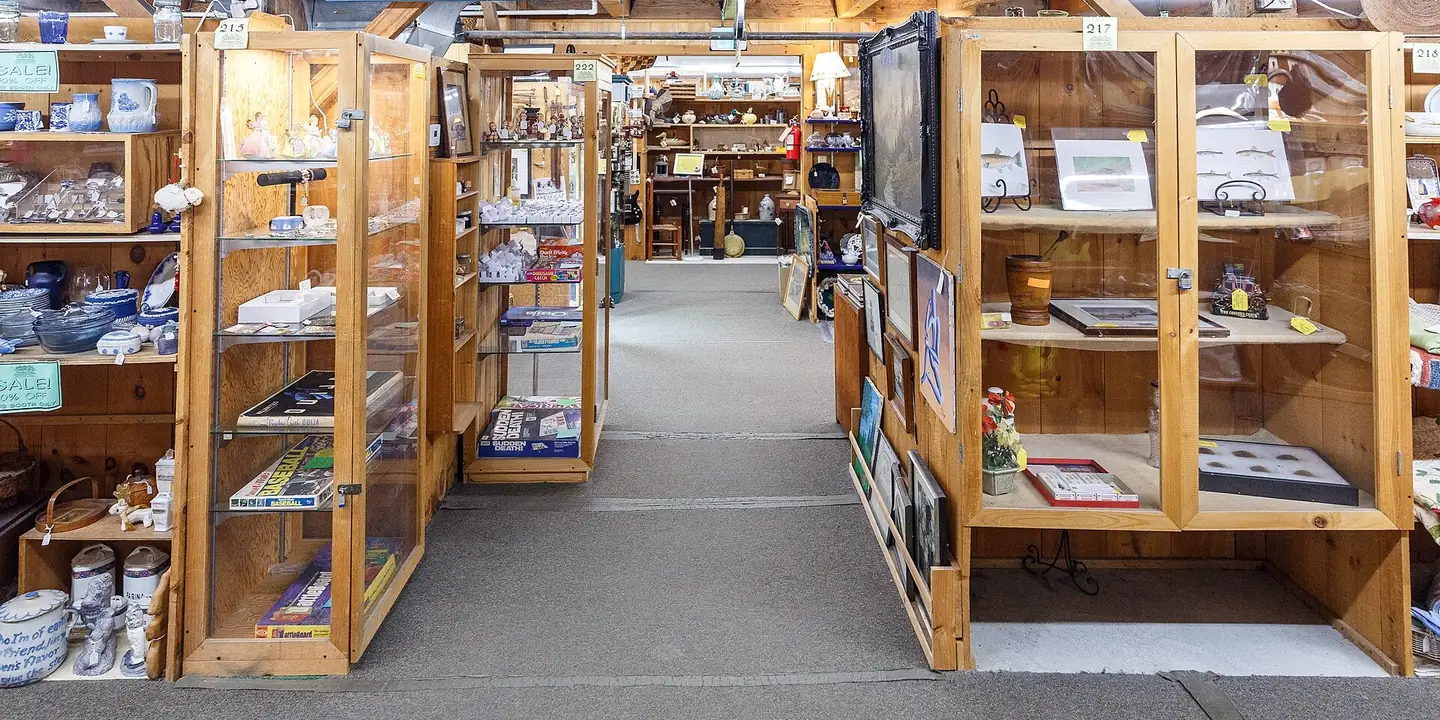

Most of the stock in an antique mall belongs to independent dealers who rent a booth, a wall or a locked case and let the mall's staff sell for them. Renting a space is the usual first step from selling a few finds online to running a small antiques business, and the terms differ more than newcomers expect. To see what malls actually offer, we read the websites of the 786 confirmed antique malls in our listings. 244 of them (31%) have a page or section for would-be dealers; 25 mention a waiting list, and only 15 publish a price.
- 786mall websites read
- 244 (31%)invite dealers or vendors
- 25mention a waiting list
- 15publish rent or case prices
- How a booth rental works
- What it costs: rent, commission and extras
- A worked example
- Choosing a mall
- Questions to ask before you sign
- Running the booth
- Consignment, co-ops and shows
- States with the most malls looking for dealers
- How we read the websites
How a booth rental works
The mall leases the building and divides the floor into spaces of different sizes: open booths along an aisle, walls for pictures and mirrors, shelves, and locked glass showcases for jewelry, coins and other small valuables. You rent one or more of those spaces by the month, fill it with your own stock, and price and tag every item with your dealer number. The mall's staff run the register, wrap purchases, collect sales tax where that applies, and send you a statement and a payment, usually monthly or every two weeks.
You are normally free to restock during opening hours, and many malls let dealers come in before the doors open. You do not have to be present to sell, which is the main attraction compared with a show or a flea market. The trade-off is that you give up some control: counter staff cannot tell a shopper the story behind a piece, and in most malls they can offer a standing discount that you set in advance, or phone you with an offer. Read what an antique mall is for the shopper's side of the same arrangement.
What it costs: rent, commission and extras
Almost every mall charges rent, and most add a commission on sales. Beyond that, the details vary mall by mall, and few put them online. Of the 244 malls with a dealer page, 15 publish any price at all; the rest ask you to call, email or visit. Here is what the pages we read do say.
Rent
Booth rent is usually quoted per square foot per month, or as a flat monthly figure for a standard booth size such as 8 by 8 or 10 by 10 feet. The 6 malls that publish a rate per square foot quote between $1.50 and $2.50, so an 8-by-10-foot booth (80 square feet) comes to roughly $120 to $200 a month at those rates. Where malls quote starting prices instead, the lowest space they offer runs from about $50 to $300 a month, from a single shelf or small bookcase up to a full booth. Spaces at the front of the store or at the end of an aisle often cost more than the same footage further back. Locked showcases are priced separately: the 5 malls that give a figure charge between $45 and $195 a month for a case.
Commission
Commission is the mall's share of each sale, deducted before you are paid. Only 7 of the dealer pages state a rate; 5 of those 7 say 10%, and the highest rate stated is 14%. One mall publishes a sliding scale that takes a higher percentage on cheap items and a lower one on items over a few hundred dollars. Another 3 malls say they take no commission at all and live on rent alone, which usually means the rent is higher. Rent and commission work together: a cheaper booth with a higher commission suits a dealer who sells little and slowly, while a dealer with strong sales is better off paying more rent and less commission.
Other charges and conditions
- Card fees. Some malls pass the credit-card processing fee on to the dealer, typically a few percent of card sales. Ask whether the quoted commission already includes it.
- Deposit. Some malls ask for a security deposit, often a month's rent; 3 of the pages we read mention one. Ask when it is returned and what can be deducted from it.
- Lease length. Month-to-month rental, or no long-term contract at all, is described on 10 dealer pages; 3 name a minimum term of three, six or twelve months. Even a month-to-month agreement usually needs 30 days' notice to leave.
- Work days. In some malls, especially co-ops, dealers work a shift or two a month at the counter. Of the pages we read, 6 say dealers never have to work, and 1 says dealers either pay the commission or work the floor two days a month instead.
- Advertising or maintenance fees. A few malls add a small monthly fee for advertising, bags and wrapping or cleaning. Ask for the full list of charges in writing.
- Payout schedule. Where the pages say when dealers are paid (11 do), the end of the month, the tenth of the following month and every two weeks all appear. Some malls deduct next month's rent from your sales before paying out.
Every figure in this section comes from the mall websites we read on October 8, 2026, and the samples are small: fewer than one mall in forty publishes a price. Treat them as the range you may meet, not as a market rate. Prices change, and the terms for a specific mall are the ones in its agreement.
A worked example
Suppose you rent an 8-by-10-foot booth at $2 per square foot, so $160 a month, in a mall that takes 10% commission. The first $178 of monthly sales covers the rent: after the 10% commission comes off, $178 in sales leaves you with $160. Everything you sell above that is yours, less the 10% and what you paid for the stock. If you sell $600 in a month, you take home $380 before the cost of your goods and your time. Run the same arithmetic with the mall's real figures before you sign, and allow for slow months: January and February are quiet in many malls, and a new booth often needs a few weeks before regular shoppers notice it.
Choosing a mall
Rent matters less than foot traffic. A booth that costs $100 more a month in a busy mall can easily outsell a cheap one in a quiet building. Things to look at:
- Opening hours. A mall that opens seven days sells for you seven days. Of the 458 malls in our listings that publish weekly hours, 84% state a Sunday opening; our Sunday antiquing guide has the details by state.
- Location and neighbors. Malls in areas with several malls close together draw shoppers who make a day of it. A mall near a highway exit or in a tourist town sees visitors a neighborhood store does not.
- Size and mix. The largest malls state several hundred dealers and bring in crowds, but your booth competes with more neighbors. Walk the mall as a shopper first: are the aisles busy, are booths well kept, are there many empty spaces? Empty booths can mean low rent and a quick start, or a mall that is losing dealers.
- What sells there. Ask the staff what moves: furniture, primitives, mid-century, jewelry, advertising, vintage clothing. Then look at the sold tags and the half-empty booths of dealers who clearly sell a lot.
- Waiting lists. A waiting list is mentioned by 25 of the malls we read. A full mall with a list is a good sign for shoppers; get your name down and visit again, since turnover among dealers is steady.
Each mall page on this site shows the hours the mall publishes, its stated dealer count and floor area, the nearest other malls and a link to the mall's own website, which is where any dealer information will be. Start from antique malls by state.
Questions to ask before you sign
- What is the rent, how is the space measured, and is the first month's rent or a deposit due before I move in?
- What is the commission, and does it include credit-card fees? Are there any other monthly charges?
- How long is the agreement, and how much notice do I give to leave or to change booths?
- Do dealers have to work shifts? How many, and what happens if I cannot?
- When and how am I paid, and what does the sales statement show?
- Who collects and remits sales tax? Do I need my own sales-tax permit or resale certificate?
- What happens if something is stolen or broken? Is there insurance, and whose?
- Can I set a standing discount? Will staff call me with offers? Can I take layaway or hold items?
- When can I restock? Is there a dealer entrance, and can I bring in large furniture?
- What am I not allowed to sell? Many malls limit new goods, reproductions, crafts or firearms, and some require a minimum share of true antiques.
- Who provides shelving, lighting and electricity, and can I paint or alter the booth?
On sales tax: in most malls the mall is the retailer at the register and handles the tax on what it sells for you, but rules differ by state and you may still need a resale certificate to buy stock tax-free. Ask the mall and check with your state's department of revenue rather than relying on a general guide.
Running the booth
- Tag everything with your dealer number, a short description and the price, exactly as the mall requires. Untagged items often cannot be sold.
- Price with the discount in mind. If you allow staff to give 10% off, build that into the tag. Round prices and clear tags sell better than tiny handwriting.
- Keep a list of what is in the booth with your cost and asking price, so you can check it against the mall's sales statement and spot missing items.
- Restock often. Regular shoppers return to booths that change. Rotate stock with the seasons and move slow items to a different shelf or lower the price after a few months.
- Use a showcase for small valuables. Jewelry, coins, watches and small silver belong behind glass; most losses in open booths are small items.
- Watch the statements. If sales do not cover rent for several months in a row, change the booth, the stock or the mall rather than waiting it out.
For how shoppers behave once they are in the mall, including why they ask for a better price and how holds and delivery work, see our shopping tips.
Consignment, co-ops and shows
- Consignment
- The mall displays your pieces among its own stock and takes a larger share of each sale, often a quarter or more, with no monthly rent. It suits a few good pieces of furniture or an estate rather than a steady business, and a few malls offer it alongside booths.
- Co-op or collective
- A store run by its dealers. Rent is usually lower and the commission small or none, but each dealer works shifts at the counter and helps run the store. Good if you have time and want to learn the trade from the inside.
- Shows and flea markets
- You pay for a space for a day or a weekend, bring your stock, sell it yourself and take it home again. More work per sale, but you meet buyers, hear what they want and keep the whole price. Many dealers do both: a booth for steady sales and a few shows a year.
- Online only
- No rent, but photographing, listing and shipping every item is work, and large or fragile pieces are hard to sell. A booth is the simplest way to sell furniture and bulky items locally.
States with the most malls looking for dealers
These states have at least 5 confirmed malls whose website has a dealer or vendor page. The count is a minimum: we read each mall's home page and up to two inner pages, so malls that keep their dealer information elsewhere are not counted. Each state link lists every confirmed mall there, with hours and a link to its own website.
| State | Confirmed malls | With a dealer page | Share |
|---|---|---|---|
| Missouri | 35 | 19 | 54% |
| Texas | 63 | 18 | 29% |
| Florida | 44 | 16 | 36% |
| New York | 30 | 13 | 43% |
| Tennessee | 38 | 12 | 32% |
| Georgia | 24 | 11 | 46% |
| Wisconsin | 20 | 9 | 45% |
| Illinois | 30 | 8 | 27% |
| Michigan | 25 | 8 | 32% |
| Virginia | 24 | 8 | 33% |
| California | 30 | 7 | 23% |
| North Carolina | 25 | 7 | 28% |
| Ohio | 33 | 7 | 21% |
| Pennsylvania | 44 | 7 | 16% |
| Indiana | 16 | 6 | 38% |
| South Carolina | 19 | 6 | 32% |
| Alabama | 22 | 5 | 23% |
| Oregon | 13 | 5 | 38% |
How we read the websites
For each of the 786 confirmed malls we read the pages saved from its own website on October 8, 2026: the home page and up to two inner pages, 1,803 pages in all. A mall counts as inviting dealers when that text has a dealer or vendor page, an application, a "booth rental" or "spaces available" notice or a waiting list. Rent, commission, lease, work-day and payout figures are read from the same text, so they cover only the malls that publish them, and a mall whose dealer page we did not save is missing from every count. Nothing here was confirmed by phone. We do not record which malls have space free today; ask the mall. If you run a mall and your terms are wrong or have changed, send a correction, and see our page for mall owners.