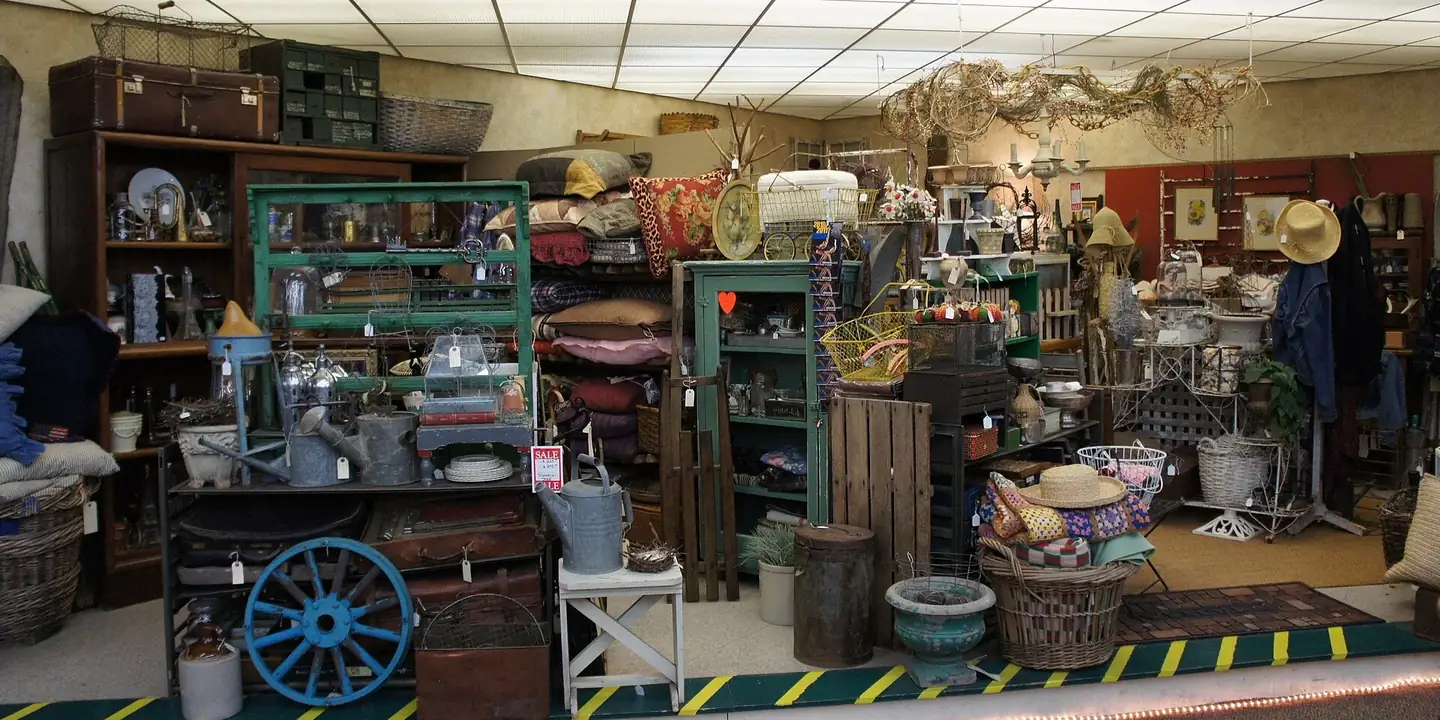

An antique mall is a single store where many independent dealers each rent a booth, a room or a glass case. The mall's own staff run the front counter, so you can pick up a lamp from one dealer and a quilt from another and pay for both at the same register. For shoppers, that means one stop covers dozens of sellers, each with their own taste and prices.
- How an antique mall works
- Other names you will see
- Antique mall, antique shop, flea market or show?
- How big are antique malls?
- How we decide a store is a mall
- Common questions
How an antique mall works
The mall owner leases the building and divides the floor into spaces. Dealers rent those spaces by the month. Depending on the mall, a dealer pays a flat rent, a commission on each sale, or both, and some malls also ask dealers to work a few shifts at the counter. The dealer stocks and prices the booth and changes it as things sell.
Each item carries a tag with the dealer's number and a price. When you check out, the staff record the sale against that number and the mall pays the dealer later. This is why the person at the register usually did not choose the item and may not know its history, and why price questions often go back to the dealer (see our shopping tips).
Valuable small pieces such as jewelry, coins, silver and pottery are often kept in locked cases near the front. Staff open them on request.
Other names you will see
Not every multi-dealer store calls itself a mall. Common names include antique center, antique market, antique emporium, marketplace, gallery, and co-op or collective. A co-op is usually run by its dealers rather than by a separate owner. The setup inside is much the same. Some stores mix antiques with crafts, new home decor or flea-market goods, and say so in their name.
Antique mall, antique shop, flea market or show?
| Type | Who sells | When it is open | What to expect |
|---|---|---|---|
| Antique mall | Many dealers renting booths; mall staff at the register | Regular store hours, often six or seven days a week | Wide range of goods and prices under one roof; dealers are rarely on site |
| Antique shop | One owner or a small team | Regular hours, sometimes by appointment | A narrower, curated stock; the owner can usually tell you about each piece |
| Flea market | Vendors at tables or stalls, often outdoors | Usually weekends, or set days | Antiques mixed with used and new goods; you deal with the vendor directly |
| Antique show | Visiting dealers who set up for the event | A few days, monthly, seasonally or yearly | Large selection for a short time; some shows charge admission |
| Consignment or thrift store | The store sells goods for owners (consignment) or from donations (thrift) | Regular store hours | Some antiques, mostly newer used goods |
How big are antique malls?
We list 793 confirmed antique malls across 47 states. Of those, 450 state how many dealers, vendors or booths they have. The typical (median) mall states about 70, and 164 state 100 or more. Among the 366 malls that publish their floor area, the median is about 12,300 square feet, and 43 state 50,000 square feet or more.
A mid-sized mall can fill an unhurried hour or two. The biggest can take most of a day. See the largest antique malls for the full rankings.
The states with the most confirmed malls in our listings are Texas (62), Florida (44), Pennsylvania (44), Tennessee (38) and Missouri (35). These counts reflect the malls we could confirm from their own websites, not every mall in each state.
How we decide a store is a mall
Many shops have "mall" in their name and many malls do not. We label a listing as a multi-dealer antique mall only when the store's own website describes it that way and states a dealer count, a size or a mall name. Everything else stays listed as an antique store. The details are on our methodology page.
Common questions
- Can you negotiate at an antique mall?
- Often, yes, but the dealer decides, not the counter staff. Many malls will phone the dealer or apply a small discount the dealer has set in advance. Some tags say a price is firm. Our shopping tips cover how to ask.
- Are the dealers there?
- Usually not. Dealers restock on their own schedules, and the mall staff handle sales. Some malls have dealers working the counter on certain days.
- Does an antique mall buy antiques?
- The mall itself usually does not buy for resale, since the stock belongs to the dealers. Staff can sometimes pass your details to a dealer who buys. If you have a lot to sell, ask whether a booth is available.
- How do I rent a booth?
- Ask at the counter or contact the mall through its website. Rent, commission, lease length and whether dealers must work shifts all vary by mall, and popular malls may keep a waiting list. Our guide to renting a booth covers what malls charge and what to ask.
- Is everything in an antique mall actually antique?
- No. Most malls carry a mix of antiques, vintage pieces, collectibles and sometimes new items. Our guide to antique, vintage and collectible labels explains the difference.
Ready to visit one? Browse antique malls by state or find malls near you.